A mirror-like part can still be a bad part. If edges are rounded, dimensions drift, recesses remain dull, or one batch looks different from the next, visual shine alone has little production value. That is why choosing a dry polishing machine should begin with the workpiece and the acceptance standard—not with motor power or machine size.
For manufacturers of precision hardware, medical-device components, decorative metalwork, fittings, and irregular machined parts, the real opportunity is repeatability. A well-developed dry polishing machine process can reduce dependence on operator-controlled hand buffing while treating several surfaces in one controlled cycle. But the result depends on part geometry, incoming condition, media, compound, loading, speed, and time.
This guide explains how planetary tumbling works, where it fits, what it cannot replace, and how to build a sample trial that produces useful purchasing evidence. If you need a shorter introduction first, read this overview of dry polishing machines.
Key takeaways
- A dry polishing machine is normally a finishing tool, not a substitute for heavy deburring, grinding, or geometry correction.
- Planetary motion creates repeated media contact, while separated workpiece compartments can reduce part-to-part collision risk.
- “Mirror finish” is not a universal machine setting; it is the outcome of the complete process chain.
- The most reliable buying method is a documented trial using representative parts and measurable acceptance criteria.
Table of Contents
What Is a Dry Polishing Machine?
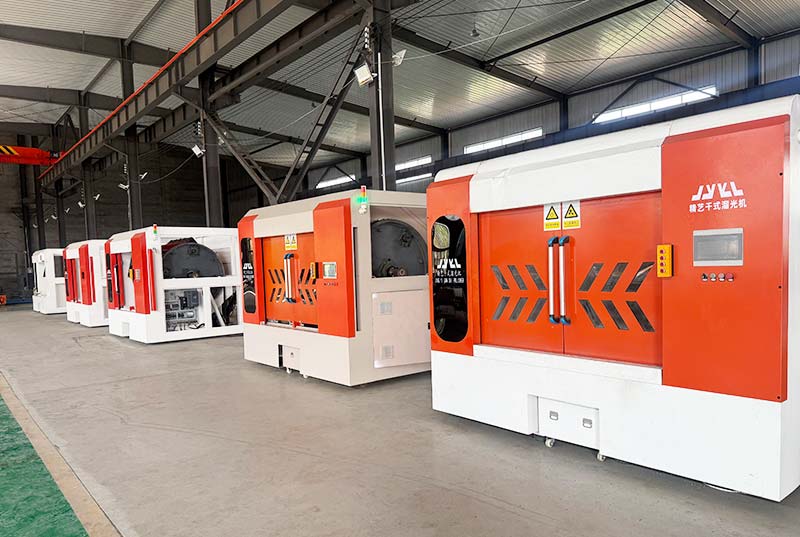
A dry polishing machine finishes metal parts through controlled friction between the workpiece, dry media, and a compatible polishing compound. Unlike wet mass-finishing processes, it does not rely on a continuously flowing water-and-compound solution during the polishing cycle. Depending on the equipment design, workpieces may rotate through media, move inside dedicated compartments, or experience a combination of rotation and revolution.
This method belongs to the broader family of tumble finishing, but not every tumbler works in the same way. A basic loose-barrel process allows parts and media to move together. A planetary system can create more energetic, multidirectional contact. A machine with adjustable compartments goes a step further by holding workpieces in defined positions, helping protect visible surfaces and delicate features from collisions with neighboring parts.
The process is especially relevant when the goal is to refine fine tool marks, improve gloss, blend small surface variations, and finish complex external shapes more consistently than manual work alone.
Why Dry Polishing Is Gaining Attention in Metal Finishing
Manufacturers rarely search for a dry process simply because it is dry. They are usually trying to solve one or more production problems:
- Manual polishing quality changes by operator, shift, or fatigue level.
- Complex parts require repeated repositioning at a buffing station.
- Small scratches or collision marks create avoidable rework.
- Cleaning and drying after a wet stage complicate material flow.
- High-mix production needs recipes that can be recorded and repeated.
- Skilled polishers are better used for exceptional features than routine surfaces.
A dry polishing machine can address these issues when the part is suitable and the process window is stable. The strongest benefit is not simply labor reduction. It is transferring more finishing knowledge from an individual operator into a defined recipe: media type, media condition, compound dosage, loading method, rotational settings, and cycle time.
That dry polishing machine recipe can then be tested, adjusted, documented, and audited. In other words, the dry process becomes part of quality engineering rather than an isolated cosmetic operation.
How a Dry Polishing Machine Uses Planetary Tumbling
The term “planetary” describes two related movements. The main assembly revolves around a central axis while individual containers or workpiece positions rotate around their own axes. The combined motion continually changes the direction and intensity of contact between the media and the metal surface.
Rotation, Revolution, and Relative Motion
Polishing does not come from speed alone. It comes from relative motion: the media must slide, roll, and press across the workpiece. Too little movement can produce slow or uneven finishing. Excessive force can increase heat, media breakdown, edge change, or surface damage. A useful process therefore balances movement with the sensitivity of the alloy and geometry.
Fixed Compartments and Collision Control
Loose parts can strike one another in conventional batch tumbling. That may be acceptable for robust hardware, but it is risky for polished faces, threads, thin edges, and parts that mark easily.
In a compartment-based dry polishing machine, movable dividers or dedicated positions can separate workpieces while allowing media to contact their exposed surfaces.
Separation does not automatically protect every feature. The fixture or compartment must still support the part correctly, leave target surfaces accessible, and avoid creating pressure points. This is why a trial with production-representative parts matters more than a demonstration with an easy sample.
Dry Media as the Working Interface
In a dry polishing machine, plant-based granules such as selected shell or cob materials can act as carriers for polishing compounds. Their size, shape, hardness, absorbency, cleanliness, and condition influence cutting action and gloss.
The compound adds chemistry and fine abrasive behavior appropriate to the metal and target finish. Machine motion supplies the energy, but the media–compound combination determines how that energy reaches the surface.
What a Dry Polishing Machine Can—and Cannot—Do
A dry polishing machine is best treated as a controlled refinement stage. It may reduce light burrs, soften fine machining marks, improve brightness, and create a more uniform appearance on accessible surfaces. Under a well-developed multistage process, suitable parts may reach a very high-gloss or near-mirror finish.
However, it should not be expected to correct every upstream defect. Deep scratches, heavy burrs, weld spatter, scale, casting pits, severe tool marks, or geometry errors usually need an earlier operation.
If a fingernail catches strongly on a scratch, polishing media may blend the surrounding surface before the defect disappears, potentially changing edges or dimensions without solving the root problem.
The process also cannot guarantee equal action everywhere. Deep blind holes, narrow slots, shielded recesses, and tightly spaced features may receive limited media movement. Highly directional decorative finishes may require a separate method because tumbling tends to create a nondirectional appearance.
Use this practical rule: remove major defects upstream; use dry polishing to refine and standardize the final surface.
The Six Variables That Control the Final Surface
A dry polishing machine is only one element of the finishing system. A stable result requires control of six variables.
1. Incoming Surface Condition
Two parts made from the same alloy can polish differently if one arrives with milled lines and the other with sanding marks. Define the upstream process, abrasive grit, heat treatment, coating status, and initial roughness. Mixing unlike starting conditions in one batch makes the result difficult to diagnose.
2. Alloy and Hardness
Stainless steel, aluminum, brass, copper, zinc alloys, and hardened steels respond differently to friction, heat, and compound. Even grades within one material family may behave differently. Never approve a recipe based only on a generic material name.
3. Part Geometry
Large flat faces, thin walls, sharp edges, threads, slots, ribs, blind holes, and cosmetic zones all change the risk profile. Mark critical-to-function and critical-to-appearance areas on a drawing or annotated photograph before testing a dry polishing machine.
4. Media and Compound
Media must reach the target surface without lodging in holes or damaging delicate details. The compound must be compatible with both the alloy and the media. Changing either one can alter cutting rate, brightness, residue, temperature, and cycle stability.
5. Loading and Part Position
Fill level affects media movement. Part orientation affects which faces receive contact. Overloading can restrict flow; underloading can change impact behavior. For separated workpieces, compartment dimensions and divider positions are part of the recipe.
6. Speed, Time, and Process Staging
Longer is not always better. A cycle may reach diminishing returns, where gloss improves very little while edge change, media wear, or temperature continues to rise.
Some applications work better with a refinement stage followed by a brightening stage than with one aggressive, extended cycle.
Dry Polishing vs. Manual Buffing vs. Wet Mass Finishing
No finishing method wins every application. Before selecting a dry polishing machine, compare the part, quality target, and production mix.
| Decision factor | Dry planetary polishing | Manual buffing | Wet mass finishing |
|---|---|---|---|
| Best fit | Repeatable refinement and brightening of suitable complex parts | Local correction, directional finishing, very low volume | Deburring, edge radiusing, smoothing, and cleaning across many part types |
| Operator influence | Lower after the recipe is validated | High | Moderate after process control is established |
| Part-to-part contact | Can be reduced with separated compartments | None during polishing | Common unless parts are fixtured or isolated |
| Access to recesses | Depends on media flow and geometry | Depends on tool access | Often good where liquid and media can circulate |
| Post-process handling | May avoid a water-based rinse/dry stage, depending on compound and cleanliness needs | Usually requires residue removal | Commonly requires rinsing, separation, and drying |
| Heavy burr removal | Generally not the ideal primary operation | Possible but labor-intensive and inconsistent | Often better suited with the correct abrasive media |
| Directional grain | Not its natural strength | Strong | Usually nondirectional |
| Recipe repeatability | High potential | Difficult to standardize fully | High potential |
A dry polishing machine often makes sense after machining, fine grinding, or pre-smoothing. Manual work can remain as an exception process for inaccessible zones or special cosmetic details.
Wet finishing may remain the better first stage when substantial stock removal or edge radiusing is required. A hybrid route is often more capable than forcing one technology to perform every task.
Which Metals and Parts Are Good Candidates?
A good dry polishing machine candidate combines a polishable alloy, media-accessible geometry, a controlled incoming surface, and a finish requirement that does not depend on directional grain.
Stainless-Steel Precision Parts
Stainless components can benefit when the goal is to reduce fine machining traces and increase brightness. Threaded areas, sealing faces, identification marks, and sharp functional edges should be protected or included in the acceptance check.
Polishing does not replace passivation where passivation is specified.
Aluminum and Zinc-Alloy Components
These softer metals require careful control because aggressive media or long cycles can change edges and highlight porosity or casting defects. Trials should monitor heat, surface haze, embedded residue, and dimensional change.
Brass and Copper Parts
These materials can develop high brightness, but compound compatibility and tarnish control matter. Establish how quickly inspected samples are handled after polishing so that comparisons are fair.
Irregular Hardware and Decorative Components
Handles, fittings, machined accessories, small hardware, and complex external forms are attractive candidates when hand polishing requires frequent repositioning.
A compartment-based dry polishing machine can be particularly useful when visible faces must be protected from part-to-part contact.
For smaller or special-size workpieces, review a compact polishing machine configuration. For larger workpieces or higher batch requirements, compare a medium- and large-part configuration.
These pages are starting points; final selection should follow a sample test and capacity calculation.
How to Select Dry Polishing Machine Media Without Damaging Part Geometry
Media selection is not a catalog exercise. Start by mapping every opening, gap, radius, and surface that matters.
- Prevent lodging. Media dimensions should not create a stable fit in holes, cross-holes, slots, threads, or narrow gaps. Test worn media too, because its size and shape change over time.
- Match aggressiveness to the defect. A harder or more abrasive combination may work faster but can increase edge loss, haze, or dimensional risk.
- Confirm access. Media must move across the target surface. If it packs into a recess without sliding, contact may be ineffective.
- Control contamination. Do not assume one media batch can be moved between every alloy. Transferred metal, degraded compound, or dirt can alter color and scratch risk.
- Define media life by performance. Replace or refresh media based on finish trend, cycle drift, contamination, and physical condition—not just elapsed time.
Run a small design-of-experiments matrix rather than changing several factors at once. For example, hold loading and speed constant, compare two media grades, then refine compound dosage and cycle time.
This creates evidence about cause and effect. It also prevents a dry polishing machine from being blamed for a media problem—or vice versa.
How to Build a Repeatable Dry Polishing Machine Trial
A dry polishing machine supplier trial should answer a production question, not merely create one attractive sample. Send parts that represent the actual range: normal parts, worst-case surface condition, delicate geometry, and more than one production lot.
Step 1: Record the Starting Condition
Photograph each part under fixed lighting. Record alloy and grade, upstream operation, existing coating or heat treatment, key dimensions, initial roughness, and known defects. Identify cosmetic zones and surfaces that must not change.
Step 2: Define Pass/Fail Criteria
Avoid “looks good.” Use measurable or repeatable criteria such as:
- Roughness at named measurement locations
- Gloss measured at a stated angle, where appropriate
- Maximum edge-radius change
- Dimensional tolerance at critical features
- No media trapped in holes or threads
- No new dents, scratches, haze, or color variation
- Approved visual sample under controlled lighting
If surface texture is specified on drawings, use a consistent framework. ISO 21920-1 covers the indication of profile surface texture in technical product documentation, while measurement method and instrument settings should be agreed with your quality team.
Step 3: Log the Full Recipe
For each dry polishing machine trial, record media identity and condition, compound amount, part count, part orientation, compartment setup, fill level, speed settings, total time, staging, and observed temperature.
A result without the recipe cannot be reproduced.
Step 4: Inspect Function Before Appearance
Measure critical dimensions, threads, mating areas, sealing faces, edge radii, and identification marks before approving shine. Then compare appearance under fixed light and viewing distance.
A glossy rejected part is still rejected.
Step 5: Repeat the Winning Condition
Run the proposed recipe again with a fresh group of representative parts. Repeatability across lots is more important than the best single specimen.
If the second run drifts, investigate loading, media condition, compound distribution, incoming surface, and inspection consistency.
Common Dry Polishing Machine Problems and Corrective Actions
Troubleshooting should change one factor at a time whenever possible.
| Symptom | Likely causes | What to check next |
| Uneven gloss | Poor media flow, inconsistent orientation, overloaded compartment, variable starting finish | Mark dull zones, reduce load, adjust position, standardize prefinish |
| Fine new scratches | Contaminated media, trapped chips, damaged compartment surface, foreign material | Screen and inspect media, clean the machine, isolate alloys |
| Rounded edges | Excessive aggressiveness, speed, pressure, or cycle time | Reduce intensity, shorten the stage, protect critical edges |
| Little improvement | Media is too mild or glazed, compound is depleted, target area is shielded | Verify media condition, dosage, access, and relative motion |
| Haze instead of brightness | Wrong media–compound pairing, excess heat, residue, incompatible alloy response | Test a gentler brightening stage and monitor temperature |
| Media trapped in features | Media size or shape matches holes, slots, or threads | Change media geometry and inspect worn media distribution |
| Batch-to-batch drift | Inconsistent loading, media age, dosage, incoming condition, or inspection | Use a setup sheet, control media refresh, and track trend data |
If a dry polishing machine produces a defect only on one part family, geometry and positioning are likely important. If the defect appears across every part, inspect media condition, contamination, recipe settings, and machine condition first.
How to Choose the Right Dry Polishing Machine
The correct dry polishing machine model is the one that can hold the real workpiece safely, move media effectively around its target surfaces, and meet required output with a validated recipe.
Start with the Largest Part Envelope
Provide maximum length, width, height, mass, and center-of-gravity concerns. Include drawings or photographs with scale. A part that physically fits may still leave too little room for media circulation.
Calculate Usable Batch Capacity
Do not compare machines only by nominal container volume. Ask how many of your parts can be loaded while maintaining separation, media flow, and finish consistency.
Include loading, unloading, inspection, and media handling in the production-rate calculation.
Match Compartments to Fragile Features
Check whether partitions are adjustable and how workpieces are supported. Confirm clearance around cosmetic surfaces and whether fixtures or protective methods are needed for threads, thin edges, or finished faces.
Evaluate Controls and Recipe Management
Useful controls should make critical settings clear and repeatable. Ask how recipes are stored, how operators confirm setup, what alarms are available, and how access to parameter changes is managed.
Plan for the Production Environment
Review electrical supply, floor loading, footprint, access for installation, ventilation or dust-control needs, ambient limits, noise management, and material handling.
A dry polishing machine still requires a controlled housekeeping plan for media fines, compound, and workpiece residue.
Explore the complete industrial polishing machine range and surface-finishing equipment portfolio, then compare configurations using your part data rather than model names alone.
Operating Safety and Preventive Maintenance
Rotating assemblies, drives, moving containers, and heavy workpieces create hazards even when the polishing media is relatively soft. Guarding, interlocks, emergency stops, lockout procedures, electrical protection, and safe loading methods should be reviewed for the installation country and workplace.
As one authoritative reference, the U.S. general machine-guarding rule 29 CFR 1910.212 addresses protection from rotating parts, flying material, and other machine hazards. It is not a substitute for a site-specific risk assessment or local regulations.
A practical preventive-maintenance routine should include:
- Inspecting guards, interlocks, emergency stops, fasteners, dividers, and containers
- Checking drive components, bearings, abnormal vibration, and unusual sound
- Removing foreign objects and accumulated fines
- Monitoring media condition, contamination, and consumption
- Verifying control settings and recipe records
- Inspecting cables, ventilation paths, and the surrounding work area
- Recording finish trends so quality drift becomes an early maintenance signal
Never reach into or service a dry polishing machine until motion has stopped and the equipment has been isolated according to the approved procedure.
Questions to Send a Dry Polishing Machine Supplier
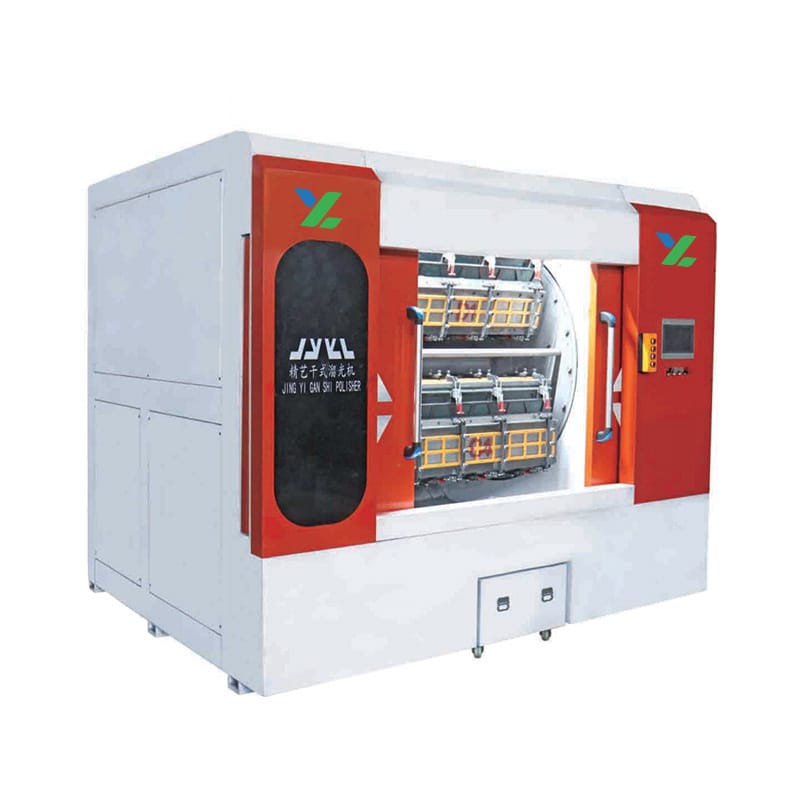
A detailed inquiry is easier to evaluate and more likely to produce a useful proposal. Send the following information:
- Part name, drawing, photographs, and annual or shift volume
- Alloy, grade, hardness, heat treatment, and coating status
- Minimum and maximum dimensions and individual part mass
- Current manufacturing route and incoming surface condition
- Defects that must be removed or reduced
- Target roughness, gloss, visual sample, and critical dimensions
- Features that must be protected from rounding, residue, or media lodging
- Available electrical supply, installation space, and handling limits
- Required traceability, recipe control, and inspection method
- Representative samples available for testing
Ask the supplier to return before-and-after measurements, photographs under consistent lighting, the full trial recipe, recommended media and compound, usable parts per batch, and observed limitations.
If you want a configuration recommendation based on real samples, send your part details and finishing target.
FAQ
Is a Dry Polishing Machine the Same as a Tumbler?
It is a type of mass-finishing equipment, but the motion and part handling can be different. Planetary rotation creates multidirectional media contact, and separated compartments can reduce part-to-part collision.
A simple loose-barrel tumbler may not offer the same movement or workpiece isolation.
Can a Dry Polishing Machine Remove Heavy Burrs?
Usually, it is better used for fine burr reduction, smoothing, and brightening. Heavy burrs, scale, deep scratches, and large tool marks often need machining, grinding, or a more aggressive mass-finishing stage first.
Can It Polish Stainless Steel, Aluminum, Brass, and Copper?
Potentially, yes, but each alloy requires a suitable media–compound combination and trial. Grade, hardness, porosity, incoming finish, geometry, and finish target all affect the recipe.
Can It Produce a Mirror Finish?
A dry polishing machine can produce a high-gloss or near-mirror surface on suitable parts under a developed process. The outcome depends on the starting surface, alloy, media, compound, access, and cycle staging.
Approve a measured sample rather than relying on the phrase “mirror finish.”
How Long Does a Polishing Cycle Take?
There is no responsible universal answer. Fine brightening of a prepared surface and removal of visible machining marks are different tasks.
Establish cycle time through timed trials and stop when further improvement becomes too small relative to dimensional risk and throughput.
Will Dry Polishing Change Part Dimensions?
Any abrasive or friction-based process can change material at some scale. The important question is whether change at critical features remains within tolerance. Measure representative points before and after repeated worst-case cycles.
Do Parts Need Cleaning After Dry Polishing?
That depends on the compound, alloy, cleanliness specification, and next operation. Some parts may need only media removal and wiping; regulated, coated, bonded, welded, or assembled parts may require a validated cleaning step.
Confirm residue acceptance rather than assuming “dry” means “clean.”
Conclusion
A dry polishing machine should be selected as a process, not purchased as an isolated piece of equipment. The machine creates controlled motion; the media and compound shape the contact; the workpiece geometry governs access and risk; and the acceptance plan decides whether the result is valuable.
The best project sequence is straightforward: standardize the incoming surface, define measurable requirements, test representative parts, log every variable, repeat the best recipe, and calculate usable batch capacity.
This approach prevents a spectacular sample from hiding production problems and turns dry polishing into a repeatable manufacturing stage.
When the workpiece is a good fit, planetary tumbling and separated compartments can reduce collision risk, improve consistency, and bring complex surfaces into a more controlled workflow.
Start with the part drawing and an honest defect map; the right dry polishing machine configuration will follow from the evidence.