Table of Contents
Rolling shear beveling limits starts with a clearly defined application. The useful starting point is the production decision: what must the equipment deliver, how will the result be checked, and which supporting operations are required? This guide uses YL-GJ26 as a relevant Yuanli product reference and separates published specifications from application conditions that require confirmation.
Rolling shear beveling limits: the decision to resolve
Rolling-shear preparation can be attractive for suitable plate edges, but its selection should follow the required groove and material rather than one advertised travel speed. Review the published angle, thickness, and bevel-width ranges together. A job near more than one limit deserves a representative supplier trial. Clarify the required surface condition and whether additional finishing is included in the route. Compare the result with the drawing at the beginning, middle, and end of the edge. Treat the supplier's validated setup as a defined application envelope. If the workpiece falls outside that envelope, investigate another process instead of forcing the original equipment choice.
Rolling shear beveling limits: review limits as a combined application
In a rolling shear beveling limits review, a specification table gives several dimensions of an application, including material thickness, angle, bevel width, and workpiece size. These should be reviewed together. The maximum value in one row does not establish that every other maximum is available simultaneously on the proposed material. Show the complete job to the supplier and ask which configuration has been validated.
For rolling shear beveling limits, the enquiry should make combined application limits explicit. Include normal work and recurring demanding work in the sample set. Where an application approaches the published boundary, request a demonstrated result and the conditions that produced it. Keep any additional preparation or finishing operation visible. This provides a defensible application decision without turning a catalogue range into an unconditional production promise.
Rolling shear beveling limits: compare access and handling before travel speed
In a rolling shear beveling limits review, a productive edge-preparation route needs suitable access to each required face. Identify upper, lower, and opposite-side operations and determine how the workpiece will be oriented between them. Ask the supplier to demonstrate the approved sequence for the selected model. Keep handling equipment and support changes in the comparison.
For rolling shear beveling limits, review bevel-width definition before using the published travel speed to estimate output. A configuration that reduces plate repositioning may have a different value from one that performs a single straightforward edge quickly. The choice depends on the recurring work mix and available handling resources. Record the whole sequence so the commercial comparison reflects completed plates rather than only time spent moving along one edge.
Rolling shear beveling limits: use tooling records that explain consumption
In a rolling shear beveling limits review, identify the installed blade or cutter arrangement and connect it to the jobs processed. Record accepted edge length together with material and groove conditions. Separate normal wear from accidental damage, setup-related problems, and replacement for another reason. Use the manufacturer's inspection and replacement instructions for the specific assembly.
A rolling shear beveling limits record should include surface requirement. Avoid publishing a universal tool-life estimate from a short demonstration or another workshop's application. Compare several similar production runs before setting replenishment expectations. When consumption changes, review the incoming material and setup record as well as the tool itself. This makes spare-tool planning more useful and helps prevent a misleading average from hiding an unsuitable job condition.
Create an application matrix instead of checking one limit
Place each recurring job in a row and record material, thickness, required angle, bevel width, minimum workpiece dimensions, and surface acceptance. Add a column for supplier confirmation and another for trial evidence. A row is not approved merely because each number appears somewhere in a catalogue.
Use the matrix to identify combinations near multiple boundaries and ask which require a representative trial. Record any preparation or secondary operation included in the supplier's answer. Jobs outside the demonstrated range should have an alternative route or a clearly stated pending review. This makes the proposed equipment's useful production scope visible without implying that every published extreme can be combined freely.
Rolling shear beveling limits: application comparison checklist
Use this rolling shear beveling limits checklist to compare a proposal with the required production condition. The rows are discussion and verification points; they are not universal machine settings or guaranteed acceptance limits.
| Review item | Question to resolve | Useful evidence |
|---|---|---|
| Combined application limits | Confirm combined application limits for the actual workpiece and order. | Annotated drawing, sample identification, or order-specific scope |
| Actual material | Keep the requirement for actual material identical across the options. | Supplier response with stated conditions and exclusions |
| Bevel-width definition | Observe bevel-width definition during the complete proposed work sequence. | Representative trial record, including supporting work |
| Surface requirement | Record surface requirement with an identified sample or configuration. | Repeatable inspection record or signed configuration detail |
| Representative trial | Assign responsibility for representative trial before release. | Named owner and agreed deliverable in the handover record |
| Alternative route for outliers | Revisit alternative route for outliers when the approved conditions change. | Updated application review with a documented decision |
Rolling shear beveling limits: relevant Yuanli equipment
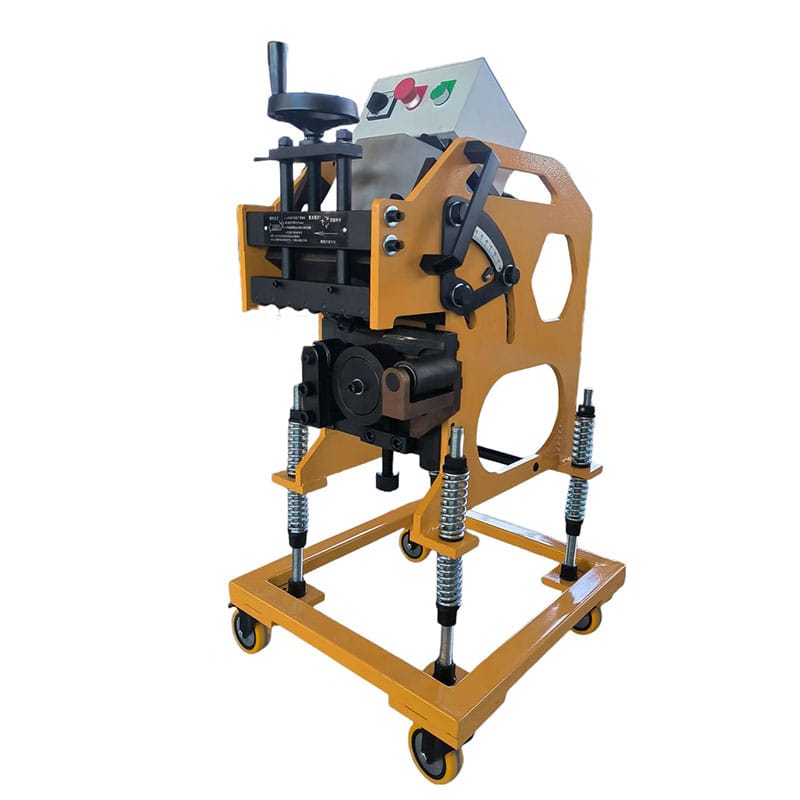
For rolling shear beveling limits, the YL-GJ26 product page provides a starting reference. Yuanli describes a compact self-propelled rolling-shear configuration for plate-edge preparation. Confirm the delivered configuration and the actual sample result before treating it as an approved production solution.
| Published item | Product-page reference |
|---|---|
| Motor power | 2,200 W |
| Power supply | 380 V / 50 Hz |
| Bevel angle | 25°–55° |
| Bevel face width | 0–25 mm |
| Single-pass bevel width | 16 mm |
| Groove types | K-, V-, X-, and Y-grooves |
| Plate thickness range | 5–50 mm |
Published limits describe reference specifications; they do not establish that every maximum can be used simultaneously. Confirm the material, geometry, tooling, support, and delivered options for the intended job.
Rolling shear beveling limits: prepare a technical enquiry
A useful rolling shear beveling limits enquiry combines the workpiece drawing, material identification, incoming condition, expected order pattern, and the acceptance requirements. Add photographs that show the relevant geometry, with dimensions or an identified reference where needed. Include combined application limits and alternative route for outliers explicitly so the supplier can respond to the actual decision.
Compare the model above with the Yuanli beveling machine range. Ask which proposed conditions have already been demonstrated and which require samples. If the scope changes during discussion, update the enquiry and keep the revised requirements with the quotation.
For terminology used in joint cross-sections, see the TWI explanation of weld-joint preparation geometry; the applicable joint dimensions still come from the approved fabrication drawing and procedure. For related Yuanli guidance, review the existing groove-inspection guide.
Ready to discuss rolling shear beveling limits for your production line? Contact Yuanli with the application package above and request a configuration review, sample-trial scope, and quotation. Use the enquiry form below to describe the job and the result you need.
Frequently asked questions
What should be defined first for rolling shear beveling limits?
Start with combined application limits and actual material. Connect them to the actual drawing, workpiece condition, and required result. The relevant model can then be evaluated against a specific application instead of a general product description.
Which evidence is useful when reviewing rolling shear beveling limits?
Request an identified sample or configuration record covering bevel-width definition and surface requirement. Preserve the method, observations, and any deviations. A selected photograph or a single nominal specification cannot replace the complete agreed verification.
Is YL-GJ26 automatically suitable for this application?
No. The YL-GJ26 page is a product reference for the rolling shear beveling limits discussion. Suitability depends on the material, complete geometry, required output, supplied configuration, and the representative evidence accepted by the buyer and supplier.
Can rolling shear beveling limits be approved from a catalogue alone?
A catalogue can support initial screening, but it does not establish every condition of the intended job. Resolve representative trial and alternative route for outliers before release. Use a representative trial whenever the required result or supporting method remains uncertain.
What should I send Yuanli about rolling shear beveling limits?
Send the relevant drawing, material and incoming-condition details, expected quantities, and the acceptance criteria. Identify combined application limits, bevel-width definition, and any unresolved constraint. Request a written response with the recommended configuration and any conditions requiring a sample trial.