Table of Contents
Polishing small threaded parts starts with a clearly defined application. The useful starting point is the production decision: what must the equipment deliver, how will the result be checked, and which supporting operations are required? This guide uses YLJY7.5KW-192 as a relevant Yuanli product reference and separates published specifications from application conditions that require confirmation.
Polishing small threaded parts: the decision to resolve
Small threaded parts require a finish specification that protects their function. Identify the threads and mating surfaces that must remain within drawing requirements, then consider whether media could lodge in the geometry. Use the actual thread form and material in the trial. Inspection should include fit and cleanliness after the proposed separation process, not only brightness on the outside diameter. If the process changes an edge or leaves retained material, evaluate a different media arrangement or another route with the supplier. A successful result on a smooth pin does not validate a threaded component of similar size. Keep the accepted process tied to the complete part geometry.
Polishing small threaded parts: identify the surfaces that must change and remain
In a polishing small threaded parts review, mark the surfaces intended for finishing and the functional features that must retain their required dimensions or shape. Threads, bores, sealing faces, locating surfaces, and edges can need different acceptance checks. Resolve ambiguous drawing language before the trial rather than allowing visual improvement to become the default definition of success.
For polishing small threaded parts, the drawing review should identify thread and fit requirements and media retention risk. Record the incoming condition at the relevant locations so later measurements have a useful baseline. A process suitable for a decorative feature may not suit an otherwise similar functional component. Ask the supplier to evaluate the complete geometry and acceptance requirement together, including any surface that is difficult to inspect.
Polishing small threaded parts: treat media access and removal as separate questions
In a polishing small threaded parts review, a finishing medium must interact with the intended surfaces, and it must also be removable from the completed component. Compare the media geometry with holes, recesses, slots, and undercuts. Consider its condition after use, since the relevant size distribution may differ from a fresh supply. Ask the supplier to identify features that need a specific trial.
For polishing small threaded parts, validate separation method using the complete separation and cleaning route. A clean outer surface does not prove that internal features are clear. Where a critical recess cannot be processed or checked reliably, define another operation or obtain a design review. Keep this limitation visible rather than extending an exterior sample result to the entire part.
Polishing small threaded parts: inspect function alongside surface appearance
In a polishing small threaded parts review, the finished component should be evaluated against all relevant drawing requirements. Select appropriate dimensional, fit, edge, cleanliness, and appearance checks rather than relying on a single surface photograph. Use identified sample locations and a consistent method. If inspection requires special equipment or expertise, confirm that it will also be available during normal production.
For polishing small threaded parts, make post-process cleanliness an explicit release condition. Compare before-and-after results where the finishing operation might alter a functional feature. Keep individual results rather than reporting only the best part or the average. This helps identify uneven processing or a geometry-related issue that would otherwise disappear in a summary.

Include fit checks after the proposed cleaning route
Identify the actual thread and mating requirement on the drawing, then agree how the finished component will be gauged or otherwise functionally checked. Evaluate parts after separation and cleaning, since retained media or residue can affect the result even when the external surface appears satisfactory.
Use representative threaded components in the supplier trial. Mark the features most likely to trap media and ask how they will be verified in production. If repeated manual removal is required, record the labour and determine whether a different process arrangement is more appropriate. Approval should cover the functional threaded component and its clean condition, not simply the appearance of a smooth external diameter.
Polishing small threaded parts: application comparison checklist
Use this polishing small threaded parts checklist to compare a proposal with the required production condition. The rows are discussion and verification points; they are not universal machine settings or guaranteed acceptance limits.
| Review item | Question to resolve | Useful evidence |
|---|---|---|
| Thread and fit requirements | Confirm thread and fit requirements for the actual workpiece and order. | Annotated drawing, sample identification, or order-specific scope |
| Media retention risk | Keep the requirement for media retention risk identical across the options. | Supplier response with stated conditions and exclusions |
| Actual material | Observe actual material during the complete proposed work sequence. | Representative trial record, including supporting work |
| Separation method | Record separation method with an identified sample or configuration. | Repeatable inspection record or signed configuration detail |
| Post-process cleanliness | Assign responsibility for post-process cleanliness before release. | Named owner and agreed deliverable in the handover record |
| Functional gauging | Revisit functional gauging when the approved conditions change. | Updated application review with a documented decision |
Polishing small threaded parts: relevant Yuanli equipment
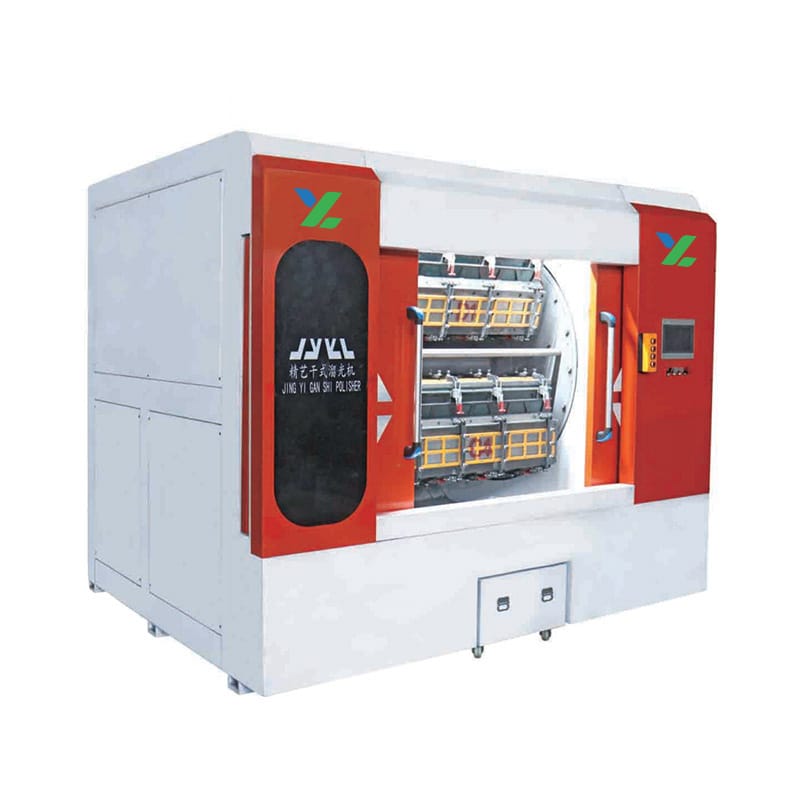
For polishing small threaded parts, the YLJY7.5KW-192 product page provides a starting reference. Yuanli presents this compact dry polishing configuration for small or specially sized workpieces, with four processing bins. Confirm the delivered configuration and the actual sample result before treating it as an approved production solution.
| Published item | Product-page reference |
|---|---|
| External power supply | AC 380 V |
| Main motor power | 7.5 kW |
| Auxiliary motor power | 2.2 kW |
| Number of processing bins | 4 |
| Bin dimensions | 672 × 200 × 200 mm; 700 × 200 × 120 mm |
| Machine weight | Approx. 1,800 kg |
| Overall dimensions (L × W × H) | 2,000 × 1,200 × 1,900 mm |
The product page lists reference electrical and mechanical data. Estimated energy figures are omitted here because their cycle or time basis is not stated clearly enough for a dependable operating-cost calculation. Confirm workpiece loading and the delivered electrical configuration with Yuanli.
Polishing small threaded parts: prepare a technical enquiry
A useful polishing small threaded parts enquiry combines the workpiece drawing, material identification, incoming condition, expected order pattern, and the acceptance requirements. Add photographs that show the relevant geometry, with dimensions or an identified reference where needed. Include thread and fit requirements and functional gauging explicitly so the supplier can respond to the actual decision.
Compare the model above with the Yuanli polishing machine range. Ask which proposed conditions have already been demonstrated and which require samples. If the scope changes during discussion, update the enquiry and keep the revised requirements with the quotation.
For general consumable background, see the Rösler overview of polishing and drying media; a media catalogue is background reading, not approval of a particular Yuanli process recipe. For related Yuanli guidance, review the existing media-selection guide.
Ready to discuss polishing small threaded parts for your production line? Contact Yuanli with the application package above and request a configuration review, sample-trial scope, and quotation. Use the enquiry form below to describe the job and the result you need.
Frequently asked questions
What should be defined first for polishing small threaded parts?
Start with thread and fit requirements and media retention risk. Connect them to the actual drawing, workpiece condition, and required result. The relevant model can then be evaluated against a specific application instead of a general product description.
Which evidence is useful when reviewing polishing small threaded parts?
Request an identified sample or configuration record covering actual material and separation method. Preserve the method, observations, and any deviations. A selected photograph or a single nominal specification cannot replace the complete agreed verification.
Is YLJY7.5KW-192 automatically suitable for this application?
No. The YLJY7.5KW-192 page is a product reference for the polishing small threaded parts discussion. Suitability depends on the material, complete geometry, required output, supplied configuration, and the representative evidence accepted by the buyer and supplier.
Can polishing small threaded parts be approved from a catalogue alone?
A catalogue can support initial screening, but it does not establish every condition of the intended job. Resolve post-process cleanliness and functional gauging before release. Use a representative trial whenever the required result or supporting method remains uncertain.
What should I send Yuanli about polishing small threaded parts?
Send the relevant drawing, material and incoming-condition details, expected quantities, and the acceptance criteria. Identify thread and fit requirements, actual material, and any unresolved constraint. Request a written response with the recommended configuration and any conditions requiring a sample trial.